

 Family Medicine
 Imaging Center Services
 Interventional Radiology
 Urgent Care
 Vein Center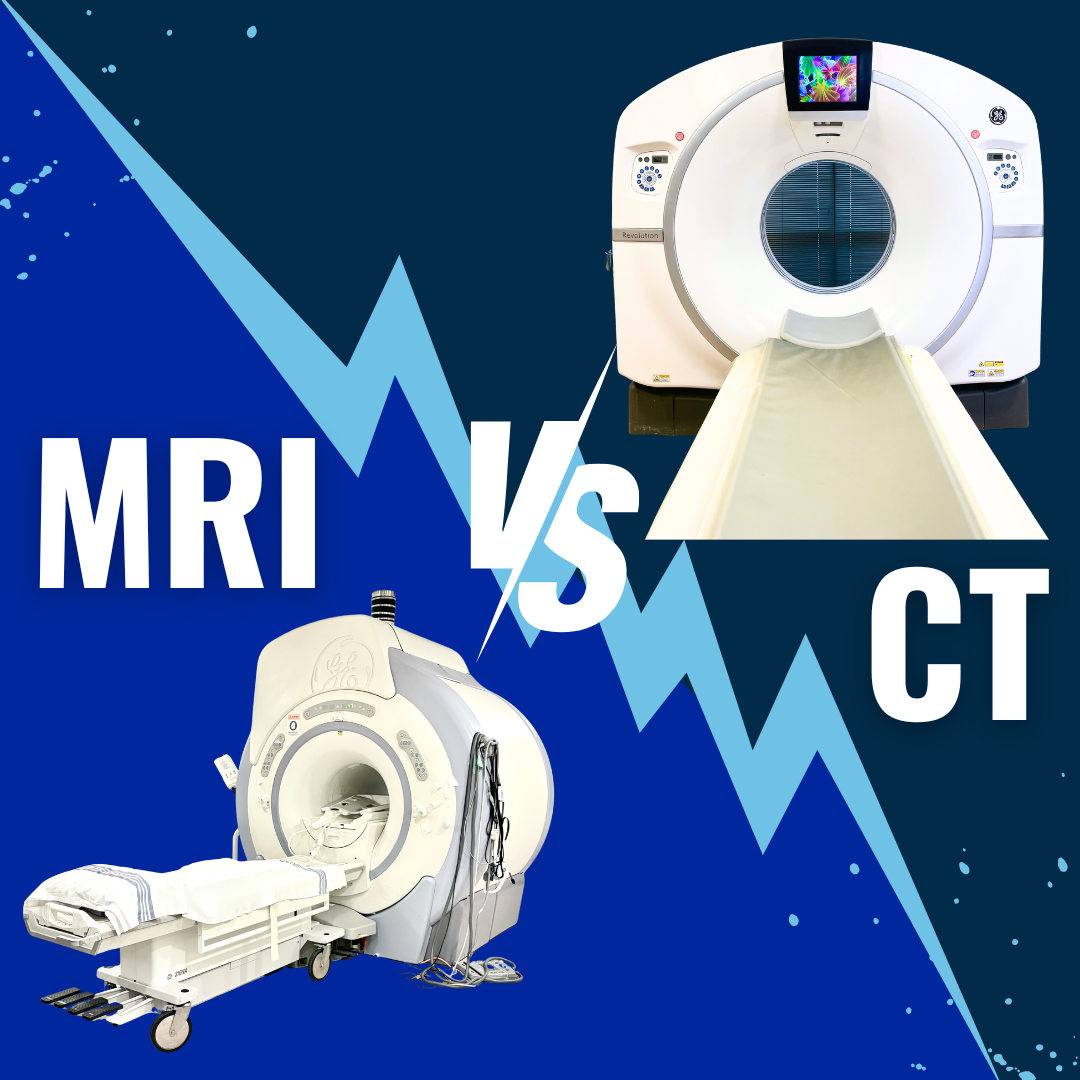
Is It an MRI or a CT? What’s the difference?
If your doctor has ever ordered imaging and you found yourself wondering, “Wait… is this an MRI or a CT?” You’re not alone. CT scans and MRIs are two of the most commonly used imaging tools in medicine, and while they can sometimes look similar to patients, they serve very different purposes. Understanding the difference can help you feel more informed, confident, and prepared for your exam. The Big Picture: What’s the Difference? The simplest way to think about it is this: Both are incredibly…
If your doctor has ever ordered imaging and you found yourself wondering, “Wait… is this an MRI or a CT?” You’re not alone. CT scans and MRIs are two of the most commonly used imaging tools in medicine, and while they can sometimes look similar to patients, they serve very different purposes.
Understanding the difference can help you feel more informed, confident, and prepared for your exam.
The Big Picture: What’s the Difference?
The simplest way to think about it is this:
- CT scans use X-rays to create detailed images of the body quickly
- MRIs use powerful magnets and radio waves to create highly detailed images of soft tissues
Both are incredibly valuable, and each shines in different situations.
What a CT Scan Does Best
A CT (Computed Tomography) scan is often the first imaging test ordered in urgent or time-sensitive situations.
Strengths of CT Imaging:
- Speed: CT scans are fast and often completed in just a few minutes
- Excellent for emergencies: Ideal for evaluating trauma, internal bleeding, stroke, or lung issues
- Great bone detail: CT clearly shows fractures and bone abnormalities
- Widely available: CT scanners are accessible and efficient for many diagnostic needs
Because CT scans use X-rays, they do involve a small amount of radiation. However, modern CT technology uses carefully controlled doses designed to keep patient exposure as low as possible.
What an MRI Does Best
An MRI (Magnetic Resonance Imaging) provides exceptional detail, especially when it comes to soft tissues.
Strengths of MRI Imaging:
- Unmatched soft tissue detail: Ideal for imaging the brain, spine, joints, muscles, ligaments, and organs
- No radiation: MRI uses magnets and radio waves instead of X-rays
- Advanced problem-solving: Excellent for complex or unclear conditions
- High contrast images: Helps differentiate between healthy tissue and abnormalities
MRIs typically take longer than CT scans and require patients to remain still for a longer period, but the level of detail they provide is often worth the extra time.
Why One Is Chosen Over the Other
Patients often wonder why their doctor orders one test instead of the other. The decision is based on several factors, including:
- The part of the body being examined
- The symptoms or suspected condition
- Whether the situation is urgent or non-emergent
- The type of detail the physician needs to see
In some cases, both CT and MRI may be used together, each providing different pieces of the diagnostic puzzle.
What to Expect as a Patient
While the machines may look different, both exams are painless and noninvasive.
- CT scans are quick and open, making them easier for patients who feel claustrophobic
- MRIs are longer and louder but provide deeper detail, and many centers offer comfort options to help patients relax
Your imaging team will guide you through the process and answer any questions before your exam begins.
CT vs MRI
CT and MRI aren’t competitors, they’re complements. Each plays a vital role in helping physicians accurately diagnose, monitor, and treat medical conditions.
If you’re ever unsure why a specific exam was ordered, don’t hesitate to ask. Understanding the why behind your imaging can make the experience feel far less overwhelming.
The right exam at the right time can make all the difference. At BlueRock Imaging, we are fortunate to offer both MRIs and CTs. We accept almost all insurances.
Visit Blue Rock Medical today

Visit Blue Rock Medical today
Address
3152 N University Ave, Provo, UT 84604
Phone Number
Hours
Monday - Friday
7am - 6pm